Socrates famously argued in Plato’s Meno, that knowledge was recollection. He didn’t mean all knowledge, of course, or all of what we would call knowledge, anyway. He didn’t mean knowledge of historical events, for example. He didn’t even mean knowledge of virtue, the subject of the dialogue. Virtue, the dialogue concludes, is not actually knowledge at all, but a kind of divine gift.
So what was the knowledge that Socrates argued is a kind of remembering?
It was mathematical knowledge. Socrates, by drawing a number of figures in the sand and by asking a series of arguably leading questions, gets a slave boy to demonstrate that he’s inherently capable of understanding the Pythagorean theorem without actually having been taught it in the traditional sense.
“At present,” observes Socrates, “these opinions, being newly aroused [in the boy], have a dreamlike quality. But if the same questions were put to him on many occasions and in different ways, you can see that in the end he will have a knowledge [ἐπιστήσεται] on the subject as accurate as anybody’s” (85c7-d1).
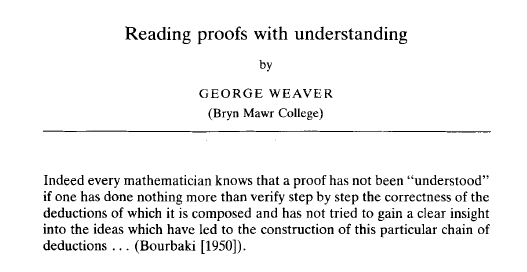
That is, the slave boy has to keep working through the proof of the theorem, according to Socrates, before he can really be said to understand it, or to know that it’s true. This coming to understand the substance of mathematical truths was hugely important to Plato, who was an admirer of Pythagoras, and it continues to be important to mathematicians even today. It’s the subject of George Weaver’s “Reading proofs with understanding” (Theoria, 1988), Weber and Mejia-Ramos’ “Why and how mathematicians read proofs: an exploratory study” (Educational Studies in Mathematics, 2011), and Hamami and Morris’ “Understanding in mathematics: The case of mathematical proofs” (Noûs, 2024).
There is something hugely important about the activity of understanding mathematical truths, but understanding is a human activity. Contemporary debates notwithstanding, machines, if it is appropriate to refer to AI as a “machine,” can’t do that. They can crank out answers to extraordinarily complex problems, but they can’t really understand what they’re doing in the sense in which human beings can understand the products of their own intellectual machinations and that is undoubtedly why their answers are so lumbering and awkward and hard for human beings, even genuinely mathematically gifted ones such as Terrence Tao, to decipher.
Even if AI did understand what it was doing, though, that would in no way deprive human beings of the pleasure of doing it for themselves. There has been a lot of wailing and gnashing of teeth among mathematicians recently over the revelation that AI may have solved some of higher math’s most intractable problems. My sense is that what mathematicians are so distressed about is not that AI can solve problems that they continue to struggle with, but that AI has beat them to the punch, so to speak. If I am right about this, then it ought to give us serious pause.
Why is being the first to achieve something so important? Does the fact that figure skating phenomenon Ilia Malinin has mastered the quadruple axel, a jump once believed to be physically impossible, mean that everyone else has given up and gone home? The very idea of that is ludicrous.
Even more ludicrous, however, is the thought that human beings would give up trying to master particular athletic feats if robot athletes mastered them first.
The lesson of the panic in the world of higher mathematics over the achievements of AI is disturbingly revealing of a deep-seated problem with contemporary values: they are profoundly misanthropic. We don’t value human achievements as such. We see nothing worthwhile in them. We value achievements, just not specifically human ones. We value results. We value being the first rather than being the best. We value winning rather than actually being good at something. We value medals, wealth, and fame, not skill, discipline, and understanding.
The problem with these misanthropic values is twofold. First, one has no direct control over extrinsic goods such as medals, etc., and so the pursuit of such things is inherently anxiety producing. Second, and more importantly, to pursue an extrinsic good such as a medal, that is only contingently tied to an intrinsic good such as understanding, is to miss out on the full experience of the latter. Really to appreciate intrinsic goods as such is to immerse oneself entirely in them, to forget everything other than the pleasure inherent in experiencing them, including whether one was the first to experience that pleasure.
Tao claims that “one cannot explore a problem as profitably and richly once one is aware of an existing solution.” Really? Is that really true? I think Plato would take exception to that claim. I don’t remember being put off the study of Euclidean geometry because Euclid had come up with his insights before me. I positively luxuriate in the intellectual feats of people who have come before me.
“Theoretical, or ‘pure’ math,‘“ observes Elisabeth Bumiller in “Why One of the World’s Greatest Mathematicians Is on a ‘War Footing’“ (New York Times, Oct. 16, 2026) “is loved as much for its art as its science.” That made me think immediately of the effect the invention of photography had on the art world. I’m not an historian, but if my memory serves me correctly, it caused a furor similar to that caused by AI among mathematicians. Now what was the point, many people asked themselves, of learning to draw or to paint, when photographs are so much better at capturing reality as it actually is?
But, of course, that panic was short lived, because photography is very different indeed from painting and drawing. Cameras do not, in fact, “see” as people see, they are far more literal and because of that, sometimes wrong. It isn’t only ourselves we sometimes fail to recognize in photos. I’ve had to reassure more than a few friends and family members that they do not look like a particular photo suggests they look. And I’m not just trying to make them feel better. Photos often fail to capture people as they appear to us.
And yet photography helped painters to better understand how people actually see, which is to say, how they actually experience their surroundings. It was the invention of photography, arguably, that led to impressionism. Teaching painters the difference between how cameras see and how people see wasn’t they only thing photography did for painting, though. Photographs actually helped various painters, such as Thomas Eakins, better understand their craft in other ways as well. Painters have used photography to study movement and anatomy and to capture fleeting moments more accurately than even the swiftest sketch could capture them.
There is not less for mathematicians to do because it appears AI can now solve problems mathematicians have so far been unable to solve. There is actually more for them to do in that they now need to check these AI “proofs” (which Tao says are hard to follow) to make sure that they actually succeed in doing what they claim to have done (because AI does make mistakes). They also need to examine how AI solves problems in contrast to how people solve them. Is there a single way that human beings think about math? “It should not be surprising,” writes Weaver, “to discover that different individuals have different global understandings of the same deductive discourse.” How different are these global understandings, though, and is there something they share that makes it easier for mathematicians to understand one another’s proofs than it is for them to understand the proofs produced by AI? And if there is a single, overarching, way human beings think about math, or a way they come to have the “insights” that, according to Weaver, “form the starting points of deductive reasoning,” is it more efficient than the way AI thinks about math? And if human mathematical problem solving is actually more efficient than AI, at least in the sense of leading to more reliable insights, can that efficiency could be transferred to AI?
It is always futile to rail against technology as such. We opened that Pandora’s box, or stole that fire from the gods, far too long ago to be able to change our minds about whether we ought to have done it. Technology can be abused, of course, but the abuse is not in inherent in the technology. It’s in the people who use it. We love blaming technology for all our ills when the problem is not in the technology, it is in ourselves, in our skewed values. And yet you almost never hear people railing against the skewed values of modern society, of how these values are robbing everyone of the joy that rightly belongs to all the intrinsic goods of human experience, including the experience of knowing, of understanding, abstract truths.
One mathematician cited in the Times article explained that he hopes one day to develop a mathematical proof “that has my DNA in it and that people will at least for that one result want to know the way I thought about something.” But why is that so important? I don’t know that I’ve ever had a truly original thought. I’m completely convinced that my thoughts are all so many reinventions of the wheel, so to speak, thoughts that others, such as Plato and Aristotle, etc., etc. have had before me (though admittedly not articulated in precisely the same way), and I find that thought enormously comforting and life affirming. It makes me feel that we are all in this endeavor we call life together and that because of that we can, and should, help one another to fully experience and appreciate all the wonderful things life has to offer! I think feeling a part of the human community in that way, brings with it an appreciation of others and a sense of obligation toward them.
What is valuable about pure math is not what technological advances it leads to. What is valuable about pure math its “purity.” What other creature is capable of exploring that realm of abstract truth? What is valuable about pure math is that it is a human endeavor, a uniquely human endeavor. I suspect that other animals probably have some rudimentary mathematical skills, but nothing, nothing that can compare with the capacity for abstract thought of human beings. The human mind is an awe inspiring thing. It invented AI and given sufficient time (assuming we have sufficient time and are not going to do ourselves in through our own incorrigible stupidity) we are going to use it to broaden and develop our understanding, which is to say, our humanity.
And that can only be good.
(An earlier version of this piece appeared under the title “What’s the Matter with Mathematicians” in the 23 October 2026 issue of Counterpunch)

